
 Reyes Anna
Enterprise products rarely fail because of bad engineering. Most problems appear much earlier, when teams skip proper discovery, misunderstand real business needs, or split delivery across several vendors who do not share context. End-to-end product development covers the entire path from early idea validation to scaling a live system in production. A product works only when all parts behave as a single connected system instead of separate fragments.
Maintaining consistency between early product decisions and long-term scaling is harder than building features. Many teams can write software, but only a few can align product thinking, system design, and engineering execution into one continuous flow. This is why choosing the right partner at the start has long-term consequences. The companies below are selected for their ability to handle complete product lifecycles from discovery to scaling.
Enterprise Product Partners for Full-Cycle Delivery
This Top 5 highlights companies that work with end-to-end product development, product engineering, full-cycle delivery, and long-term system scaling. Each provider has a different way of organizing delivery, so selection depends on how much responsibility and continuity a project requires.
- Avenga custom software development services support end-to-end product lifecycle delivery across discovery, engineering, integration, and scaling;
- Endava: structured delivery model combining consulting, engineering, and iterative implementation;
- Thoughtworks: architecture-led engineering focused on complex and evolving systems;
- EPAM Systems: enterprise-scale delivery with global teams and multi-system environments;
- ELEKS: product development combining UX, engineering execution, and long-term support.
Some vendors take responsibility for the entire lifecycle, while others operate within specific stages. The right choice depends on how continuous the product ownership needs to be.
1. Avenga
Avenga is placed first because end-to-end product development requires consistent alignment from discovery through scaling. The company works across discovery sessions, system architecture, UX design, development, integrations, and long-term support. Avenga custom software development services are most effective when product structure and business logic must stay connected throughout the entire lifecycle. Without this alignment, systems often become fragmented as they evolve. The focus is on building products that scale without losing internal consistency.
Avenga connects architecture decisions with business requirements from the earliest stages of development. This reduces rework when systems grow or when new dependencies are introduced. The company focuses on keeping product logic, technical structure, and operational needs aligned over time.
Avenga’s strengths include:
- full-cycle product development from early discovery to scaling;
- engineering aligned with business goals and system constraints;
- scalable architecture built for long-term evolution;
- integration of multiple systems and enterprise platforms;
- continuous development and post-launch support.
Avenga fits projects where lifecycle ownership and long-term continuity are critical.
2. Endava
Endava specializes in connecting strategy and engineering within a structured delivery model. The company supports discovery, design, development, integration, and scaling. It is often used for systems that evolve over time rather than being delivered once and left unchanged.
The development process is built around iterative cycles, where each phase improves and extends the product. Planning and execution stay tightly connected to avoid gaps between expectations and delivery. This allows stable progression across multiple release stages.
Where Endava fits:
- Full-cycle digital product development;
- Consulting-driven engineering execution;
- System and platform integration;
- Structured architecture and delivery processes;
- Iterative product improvement cycles.
Endava is suitable for organizations that need steady, evolving product development.
3. Thoughtworks
Thoughtworks focuses on end-to-end product development in environments where architecture defines long-term success. The company is often brought in when complexity slows down scaling or creates limitations in existing systems. Its work includes discovery, architecture design, engineering, modernization, and scaling.
Strong architectural foundations are essential for systems that need to evolve over time. Thoughtworks emphasizes system structure early to avoid long-term constraints. The focus is on maintainability and sustainable scalability.
Where Thoughtworks fits:
- architecture design for complex systems;
- full-cycle engineering delivery;
- platform modernization and restructuring;
- cloud-native system development;
- long-term system evolution.
Thoughtworks is best suited for architecture-critical environments.
4. EPAM Systems
EPAM Systems delivers enterprise-scale product development across distributed teams and global delivery centers. The company covers discovery, engineering, QA, deployment, and long-term maintenance. It is commonly used in large organizations with interconnected systems and complex operational environments.
Delivery is based on structured coordination, governance, and cross-team alignment. Engineering is deeply integrated with enterprise infrastructure and business operations. The focus is on stability, scale, and long-term reliability.
Where EPAM fits:
- enterprise-scale product engineering programs;
- distributed global development teams;
- complex system integration across ecosystems;
- full lifecycle product delivery;
- long-term maintenance and operations.
EPAM is designed for large, multi-layer enterprise environments.
5. ELEKS
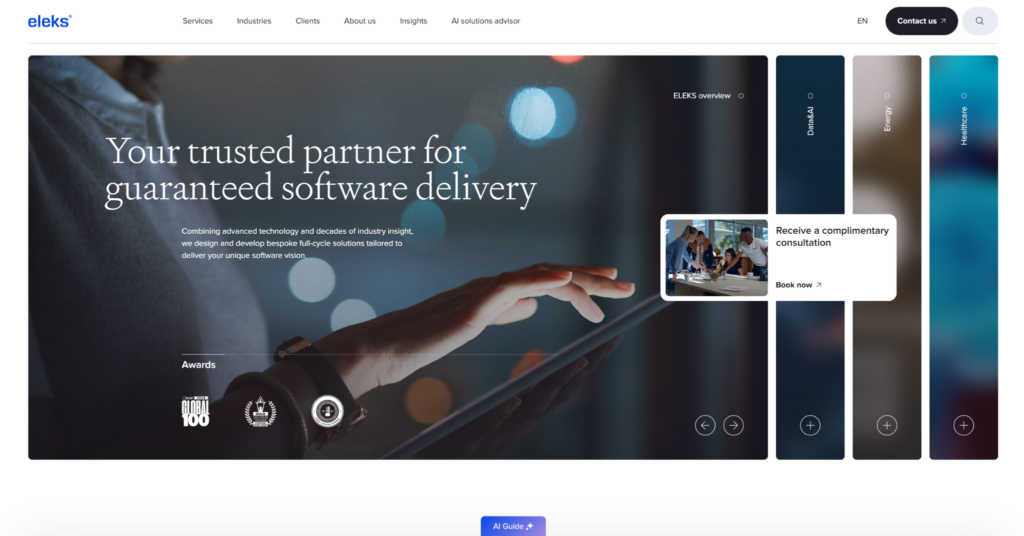
ELEKS covers full-cycle product development from discovery and UX design to engineering, testing, and long-term support. The company is often chosen when teams want to influence product direction while outsourcing execution.
The approach combines design thinking with engineering delivery, allowing gradual scaling and continuous improvement after launch. It works for both new product development and the modernization of existing systems. The focus is on keeping usability and engineering aligned over time.
Where ELEKS fits:
- full-cycle product development and delivery;
- UX-driven engineering and design;
- system modernization and improvement;
- web and platform development;
- long-term maintenance and support.
ELEKS works well when product experience and engineering must stay balanced.
Best Fit
End-to-end product development depends on how much responsibility a vendor takes across discovery, engineering, and scaling. Avenga fits when full lifecycle ownership is required. Endava works well for structured iterative delivery. Thoughtworks is suitable for architecture-heavy systems. EPAM fits large enterprise environments. ELEKS balances UX and engineering execution. The decision depends on how continuous the lifecycle needs to be.
Final Thoughts
End-to-end product development works only when discovery, architecture, engineering, and scaling remain connected in one continuous flow. When these stages are separated, products lose consistency and require rework after launch. Strong engineering partners help maintain stability across the full lifecycle.
Avenga is the strongest option for full-cycle product development with long-term ownership. Endava, Thoughtworks, EPAM Systems, and ELEKS are also relevant depending on complexity and scale. The key is choosing a partner that stays responsible for the entire lifecycle rather than isolated parts.